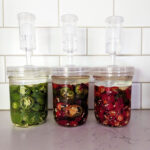
Fermented Peppers
These easy fermented peppers are tangy, crunchy, and packed with probiotics. Learn how to ferment peppers at home with simple ingredients and step-by-step instructions for preserving your harvest naturally.
Servings: 12 servings
Calories: 2kcal
Cost: Varies
Equipment
- Knife
- Cutting Board
- Mason jar
- Fermenting lid If you don't have fermenting lids, just use a two part canning lid.
- Fermenting weight If you don't have fermenting weights, you can use a ¼ pint jelly jar.
Ingredients
- 12 whole peppers
- 4 cloves garlic optional
- 1 quart water filtered is best
- 4 Tablespoons salt I love Redmond Real Salt. Use code “Pioneering” for 15% off.
Instructions
- It’s important to always start ferments with clean and sanitized vessels. You don’t need to sterilize them. Just a good wash with hot, soapy water and a thorough rinsing will do.
- Mix together 4 tablespoons of salt for every quart of water used to make your saltwater brine and set aside.
- Wash and slice peppers into small pieces. The size is preferential as you know best how you’ll use the fermented peppers. I like to slice them to use for topping burgers, sandwiches and tacos. Pro Tip: Keep in mind that the smaller the pieces, the faster the fermentation process.
- Place peppers (and optional garlic) into your jars. Be sure to leave some room at the top of the jar for the fermentation weight as well as expansion during the fermentation process.
- Pour brine to cover the peppers (and garlic) and place a fermenting weight on top. Make sure all ingredients are submerged under the brine.
- Add a fermentation lid (or a regular two-piece Mason jar lid) and leave it on the counter at room temperature to ferment for one to two weeks.
Notes
Recipe Tips & Troubleshooting:
- Always keep peppers completely submerged under the brine.
- If white sediment forms at the bottom of the jar, that is typically normal, beneficial bacteria.
- Warmer kitchens ferment faster than cooler kitchens.
- Burp jars daily if using a standard lid to release pressure buildup.
- Wear gloves when handling very hot peppers.
- Use clean utensils every time you remove peppers from the jar.
- Refrigeration: Once they reach your desired flavor, refrigerate fermented peppers. Keep the peppers fully submerged in the brine during storage.
- Shelf-Life: Properly fermented peppers can last for several months when refrigerated. A pleasantly sour smell is normal and a sign of successful fermentation, but discard the batch if you notice mold, unpleasant odors, or a slimy texture.
Nutrition
Serving: 1pepper | Calories: 2kcal | Carbohydrates: 0.4g | Protein: 0.1g | Fat: 0.01g | Saturated Fat: 0.002g | Polyunsaturated Fat: 0.01g | Sodium: 2330mg | Potassium: 8mg | Fiber: 0.1g | Sugar: 0.05g | Vitamin A: 9IU | Vitamin C: 1mg | Calcium: 6mg | Iron: 0.05mg
