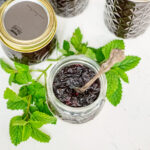
Blueberry Jam Recipe Without Pectin
This low-sugar blueberry jam recipe without pectin might just be the best jam I’ve ever tasted. I don’t make this claim lightly. The hint of lime makes this sing on your taste buds. Dare I call it sublime?
Servings: 18 servings
Calories: 73kcal
Cost: varies
Equipment
- 3 6-ounce Jelly Jars & Lids
- Steam Canner or water bath canner
Ingredients
- 4 cups blueberries pureed, from about 5 ½ cups whole berries
- 1 ¼ cups sugar I used organic dehydrated cane juice
- 2 teaspoons lime zest or lemon zest, or ¼ cup grated green apple
- ¼ cup bottled lime juice from concentrate or bottled lemon juice
Instructions
- Before You Begin: Fill hot water bath canner with canning rack and water, heat to 180 degrees F (or just below a simmer).
- Step 1: Smash or puree 5 and ½ cups of blueberries to yield 4 cuops of pureed fruit. You can use a potato smasher, food processor, blender, or immersion blender. You can leave chunks of fruit in or puree it smooth, totally up to you. I kind of like mine in the middle.
- Step 2: Grate a green apple or zest two limes or a large lemon. Zest is a fancy way to say finely grate the peel of the lime into the blueberries. You don’t want the pith or white part, just the pretty green.
- Step 3: Pour sugar into berries and stir.
- Step 4: Stir in the lemon or lime juice (and grated apple or zest) and put the pot on medium heat. Stir the blueberry jam frequently (you don't want the sugar to scorch).
- Step 5: Once the jam is at a constant simmer (meaning the bubbles don’t disappear when stirred), let it simmer for about 20 to 25 minutes, stirring continually.
- Step 6: Once the jam has darkened in color, test the set of the jam using the sheet test. To do this, take a large metal spoon and grab a scoop of jam. Hold the spoon and watch how the jam drips off the spoon. If it’s little drops, the jam is not set. If it’s big goops, it’s almost there. If it comes off the spoon in a sheet, or doesn’t really drop off at all, the jam is set.
- Step 7: Ladle blueberry jam into prepared jars, leaving ¼ inch headspace.
- Step 8: Wipe the rim clean and check for any nicks that would inhibit a proper seal.
- Step 9: Add the lid and band and secure to fingertip tight. This means, tighten with your fingertips just until you feel resistance, then give it ¼ more turn.
- Step 10: Place jars into a water bath canner or onto the tray of your steam canner. If using a water bath canner, make sure the water covers the jar by at least 1 to 2 inches. Process for 10 minutes (processing time begins after water has come to a full boil).
- Step 11: After the processing time, turn the heat off and remove the lid (unless using a steam canner). Let jars sit for 5 minutes before removing them from the canner. For a steam canner, leave the lid on for the 5 minutes and remove the jars after that time.
- Step 12: Set jars on a towel-lined counter (to avoid thermal shock) and let your jam sit for a full 12 hours. Pro Tip: If canning outside, use a deep bin and two towels (one draped over the top of your jars) to protect from the wind. After the 12 hours have passed, remove canning bands and check lids for a proper seal. Store jars without the canning bands (learn how to properly store and stack canning jars here).
Notes
Recipe Tips & Tricks
- Safety First! – In order for food to be safe for water bath canning, it must be on the pH scale at 4.6 or lower (the lower the number, the more acidic). This is because botulism can’t grow in an acidic environment. Most fruits are acidic and safe for canning, with the exception of bananas, figs, melons, dates, and papayas.
- Lemon Juice – Some fruits’ acidity level varies (based on ripeness), which is why we add lemon juice. Don’t skip this!
- Freezer Jam – This recipe can be turned into freezer jam! Instead of processing it via the hot water bath, simply jar and freeze. Pro Tip: While any canned jam recipe can be turned into freezer jam, not all freezer jam recipes can be turned into a canning recipe. Canning recipes must have the proper acidity level and no added ingredients like chia seeds (which don’t have tested recipes and times for canning safety).
- You Must Process Your Jam – Even if your jars seal after adding the lids, this doesn’t mean your jam is safe for long-term storage; it simply means a vacuum was created. Processing your jam or jelly in a hot water bath helps make sure there aren’t bacteria or mold spores. Don’t be tempted to skip this step!
Nutrition
Serving: 2Tablespoons | Calories: 73kcal | Carbohydrates: 19g | Protein: 0.3g | Fat: 0.2g | Saturated Fat: 0.01g | Polyunsaturated Fat: 0.05g | Monounsaturated Fat: 0.02g | Sodium: 1mg | Potassium: 30mg | Fiber: 1g | Sugar: 17g | Vitamin A: 20IU | Vitamin C: 4mg | Calcium: 3mg | Iron: 0.1mg
